Showing posts with label photos. Show all posts

Sunday, June 7, 2009

More documentation...

I walked around the property again, just to get a good idea of what's going on in the places that I'm not visiting every day (though even in the few acres immediately around us, I find myself surprised to see whats growing!). Here's an example of things right around my house that I forgot to include in the last post...


Some of the flowers have died, but it's a really pretty little plant that Ive spotted in a few locations.

Here's a tour of the places we don't visit as often but are right around us.

This is one of the most beautiful places on the property. We have a grove of live oaks, water oaks and a few pines. Its nice and shady during the day and so far hasn't been heavily disturbed by the tallows.

A pine tree killed by pine beetles.

A surviving pine tree.

A live oak hidden in a tallow forest.

This area is often wet and boggy and was also heavily fertilized for decades when the cows were here. As a result things grow very well and there are tons of butterflies, moths and dragonflies.

I stopped along the way to eat some fresh blackberries :)

That's it for now. Another update coming soon!

Friday, June 5, 2009

Overall land survey.

I've been busy researching the few different species that I can identify out here. The purpose of doing this is to try an catalog any native species we may have growing. It has slowly sunk in that because this is old pastureland, the chances of any healthy remnants of prairie being out here is pretty slim. The original composition of this area was probably pine forests anyway, so it's very unlikely that native prairie plants would suddenly show up in a heavily grazed field.

Here's a quick description of what I have identified (sorry, my pictures have come out blurry):
Around us:
-Horse Nettle

-Bahia grass

-tallow tree, of course
-dewberry, blackberry

-smartweed

-thistle (bull thistle I think)

In the bog:
-lizards tail
-pickerel weed

Some other things I *may* have identified:
-little quaking grass?

-vasey grass?

Without having identified everything, at least a few things are pretty clear. Almost all of these species can be considered invasive *but* most are especially common in disturbed soils, or land that has been overgrazed. No big surprise there, but it's useful information because that means with a good management plan, we can get some more native species established. Eventually, after several years, some of the plants that rely on overgrazing to be competitive will back off and some of the native grasses and wildflowers will start to take over. According to the Meadow Makers, when the natives get established, controlled burns can be used on a regular basis to manage the health of the prairie.

Our neighbor Rodney came with a bush hog yesterday to mow the area around our house and he also cut some paths through the fields and cleared the areas around my newly planted trees. A little bit of lawn makes the place seem so different and I won't deny that I kind of enjoy it. Especially for now, because it gives me a better idea of how much room we have and how the different gardening areas (wild grasses vs vegetables vs some ornamentals and shade trees) can be arranged. He left two huge patches (maybe 2500 sq ft each) out front with a path bording them. The path gives it kind of a "neat" look, plus makes it nicer to walk around and look at things.

I am thinking if we leave those areas for the native grasses and wildflowers, we can even have a border. Ronnie has a bunch of piles of antique bricks that are behind the old hay barn (lying beneath the bamboo forest). I think those would be beautiful as a border, though I'm not sure if there are enough for that whole area.

This is what I've been up to the past few days. A lot of my time is spent on research and walking around looking at things, trying to visualize and plan the best arrangement.

I also tend to have a problem with excessive enthusiasm. In other words, I'm easily distracted so it takes me quite a while to finish different projects.

Even writing this blog has taken nearly two hours because a little yellow songbird came and sat in my window and I spent awhile trying to figure out what it was at whatbird.com.
Then I got sidetracked again by Cornell University's Project FeederWatch.

I'm a huge nerd.

Tuesday, June 2, 2009

More on Tallow

An excellent point was brought up by Thais over at Port Hudson Organics, that the bees love the Tallows!
Earlier in the spring when the weather was a bit cooler, Callum and I were walking around the field and made our way over to one of the tallow tree circles (I'll tell you about these in just a minute). The trees had just begun blossoming and as we neared the trees we heard a constant electric hum. Upon closer inspection I saw that the trees were buzzing with wild honeybees! This is quite a reassuring sound amid reports of declining honeybee populations.
The American honeybee is a welcome presence in any garden and the long, golden, chain-like flowers of the Tallow are a honeybee favorite.

Any Tallow management project would have to take into account the benefit of these trees for wildlife. Not only do the bees love'em, but the birds do too. Of course, the birds end up being part of the problem when they spread the seeds to surrounding natural areas.
It is most likely that our project on the farm would be a management project rather than eradication. The Tallow tree problem in some southern states has gotten to the point where landowners are advised by the state to remove these trees from their property entirely. However, as young and energetic as I am, I can't imagine the cost and energy required to rid the property of these trees (nor do I want to think about all the herbicide that would have to be used if we found ourselves forced to take that route).


Here is an idea of what we are dealing with. The picture above is the property immediately in front of our house. Every tree you see, besides the lonely maple sapling up in front, is a Tallow. While the cows were here, they grew up along the fence lines. The "Tallow Tree Circles" are 3 big circles next to our house where the trees were cut down and piled up about 20-30 years ago. The area was not mowable because of the huge debris pile, and the seeds of the "debris" trees were able to germinate and grow undisturbed. In the back of the property where there are still a few old oaks, gum, pine and maple growing, the Tallow is busy taking over the understory and competing with the younger versions of these already established trees.

Ultimately it would be nice just to clear out patches of these trees at a time and establish and nurture the growth of other species that are equally hospitable to the wildlife. It would probably be a good idea to start with the areas where seedlings of other species are already trying to establish themselves. Help those along first, and clear out the Tallow competition. Later, we could move on to the mini Tallow forests themselves.

We are still thinking of ways to approach this issue, and any suggestions or feedback are certainly appreciated!

Monday, June 1, 2009

Tallow Tree Daydreams.


Occasionally I find myself absorbed in daydreams of eradicating the Tallow Tree. I spent some time earlier today wandering around photographing the Tallow for a new web lens I'm creating that focuses on managing Chinese Tallow. Control of this species is critical to preserving the property. Take a look at the link to find out more.
Also, after I wrote the last entry I decided to go out and get a few things done. I made the border for a vegetable bed in the front and moved some gravel from under the trailer to make a path so I don't end up walking through mud while trying to get to the veggie bed. I also repotted some of the young cacti that Ronnie gave me.

I took tons of photos this evening of the various grasses and plants growing out in the field. I will organize it into a photo tour in one of my upcoming entries, so stay tuned!

Thursday, April 23, 2009

Wednesday, February 25, 2009

Our home site.

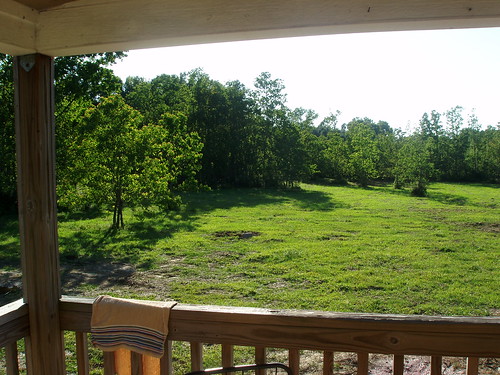
Here is our land. This is where it all begins....