Monday, June 8, 2009

Community.

When I write, I'm usually nursing or wrestling with my 6 month old. Now that he's crawling we've worked out a system where I have the laptop on the floor and he chases me around, or I chase him around. My work is punctuated by cuddling and kissing and constant tug-of-war with the objects he just can't wait to sample.
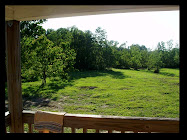
He is always happy for a break, though-- a trip around the yard, visiting the chickens, or just sitting on the porch. It's a good life we have.

One of our friends came over last Friday and Seth played his guitar as the sun set behind him. The light faded out of the sky and Brennan joined in, singing some lyrics he had written down. The vibes were so positive.


"This is what it's all about. This is what we're doing," I realized. Seth nodded with understanding.
That moment illuminated this whole "dream" that I have. This is the human aspect of the dream. Moments like these are the reasons, on a personal level, for seeking self-sufficiency and preserving nature.

I spend a lot of time thinking about this project and that project and trying to figure out how to get things going and how to make things work out. Even though I know that the whole point of all of this is each individual moment I can't help but get caught up in the planning. It's not even the final outcome that I am considering, because I never envision a final outcome... just a constant, steady work-in-progress.

On that note, I'm going to get a little more reading in while the little one is asleep... so I can spend time with him when he wakes up! :)

Sunday, June 7, 2009

Layout

Just a warning... I will be experimenting with the layout of the blog for a few days so be prepared for some changes until I get it right. Thanks!

More documentation...

I walked around the property again, just to get a good idea of what's going on in the places that I'm not visiting every day (though even in the few acres immediately around us, I find myself surprised to see whats growing!). Here's an example of things right around my house that I forgot to include in the last post...


Some of the flowers have died, but it's a really pretty little plant that Ive spotted in a few locations.

Here's a tour of the places we don't visit as often but are right around us.

This is one of the most beautiful places on the property. We have a grove of live oaks, water oaks and a few pines. Its nice and shady during the day and so far hasn't been heavily disturbed by the tallows.

A pine tree killed by pine beetles.

A surviving pine tree.

A live oak hidden in a tallow forest.

This area is often wet and boggy and was also heavily fertilized for decades when the cows were here. As a result things grow very well and there are tons of butterflies, moths and dragonflies.

I stopped along the way to eat some fresh blackberries :)

That's it for now. Another update coming soon!

Friday, June 5, 2009

Overall land survey.

I've been busy researching the few different species that I can identify out here. The purpose of doing this is to try an catalog any native species we may have growing. It has slowly sunk in that because this is old pastureland, the chances of any healthy remnants of prairie being out here is pretty slim. The original composition of this area was probably pine forests anyway, so it's very unlikely that native prairie plants would suddenly show up in a heavily grazed field.

Here's a quick description of what I have identified (sorry, my pictures have come out blurry):
Around us:
-Horse Nettle

-Bahia grass

-tallow tree, of course
-dewberry, blackberry

-smartweed

-thistle (bull thistle I think)

In the bog:
-lizards tail
-pickerel weed

Some other things I *may* have identified:
-little quaking grass?

-vasey grass?

Without having identified everything, at least a few things are pretty clear. Almost all of these species can be considered invasive *but* most are especially common in disturbed soils, or land that has been overgrazed. No big surprise there, but it's useful information because that means with a good management plan, we can get some more native species established. Eventually, after several years, some of the plants that rely on overgrazing to be competitive will back off and some of the native grasses and wildflowers will start to take over. According to the Meadow Makers, when the natives get established, controlled burns can be used on a regular basis to manage the health of the prairie.

Our neighbor Rodney came with a bush hog yesterday to mow the area around our house and he also cut some paths through the fields and cleared the areas around my newly planted trees. A little bit of lawn makes the place seem so different and I won't deny that I kind of enjoy it. Especially for now, because it gives me a better idea of how much room we have and how the different gardening areas (wild grasses vs vegetables vs some ornamentals and shade trees) can be arranged. He left two huge patches (maybe 2500 sq ft each) out front with a path bording them. The path gives it kind of a "neat" look, plus makes it nicer to walk around and look at things.

I am thinking if we leave those areas for the native grasses and wildflowers, we can even have a border. Ronnie has a bunch of piles of antique bricks that are behind the old hay barn (lying beneath the bamboo forest). I think those would be beautiful as a border, though I'm not sure if there are enough for that whole area.

This is what I've been up to the past few days. A lot of my time is spent on research and walking around looking at things, trying to visualize and plan the best arrangement.

I also tend to have a problem with excessive enthusiasm. In other words, I'm easily distracted so it takes me quite a while to finish different projects.

Even writing this blog has taken nearly two hours because a little yellow songbird came and sat in my window and I spent awhile trying to figure out what it was at whatbird.com.
Then I got sidetracked again by Cornell University's Project FeederWatch.

I'm a huge nerd.

Tuesday, June 2, 2009

More on Tallow

An excellent point was brought up by Thais over at Port Hudson Organics, that the bees love the Tallows!
Earlier in the spring when the weather was a bit cooler, Callum and I were walking around the field and made our way over to one of the tallow tree circles (I'll tell you about these in just a minute). The trees had just begun blossoming and as we neared the trees we heard a constant electric hum. Upon closer inspection I saw that the trees were buzzing with wild honeybees! This is quite a reassuring sound amid reports of declining honeybee populations.
The American honeybee is a welcome presence in any garden and the long, golden, chain-like flowers of the Tallow are a honeybee favorite.

Any Tallow management project would have to take into account the benefit of these trees for wildlife. Not only do the bees love'em, but the birds do too. Of course, the birds end up being part of the problem when they spread the seeds to surrounding natural areas.
It is most likely that our project on the farm would be a management project rather than eradication. The Tallow tree problem in some southern states has gotten to the point where landowners are advised by the state to remove these trees from their property entirely. However, as young and energetic as I am, I can't imagine the cost and energy required to rid the property of these trees (nor do I want to think about all the herbicide that would have to be used if we found ourselves forced to take that route).


Here is an idea of what we are dealing with. The picture above is the property immediately in front of our house. Every tree you see, besides the lonely maple sapling up in front, is a Tallow. While the cows were here, they grew up along the fence lines. The "Tallow Tree Circles" are 3 big circles next to our house where the trees were cut down and piled up about 20-30 years ago. The area was not mowable because of the huge debris pile, and the seeds of the "debris" trees were able to germinate and grow undisturbed. In the back of the property where there are still a few old oaks, gum, pine and maple growing, the Tallow is busy taking over the understory and competing with the younger versions of these already established trees.

Ultimately it would be nice just to clear out patches of these trees at a time and establish and nurture the growth of other species that are equally hospitable to the wildlife. It would probably be a good idea to start with the areas where seedlings of other species are already trying to establish themselves. Help those along first, and clear out the Tallow competition. Later, we could move on to the mini Tallow forests themselves.

We are still thinking of ways to approach this issue, and any suggestions or feedback are certainly appreciated!

Monday, June 1, 2009

Tallow Tree Daydreams.


Occasionally I find myself absorbed in daydreams of eradicating the Tallow Tree. I spent some time earlier today wandering around photographing the Tallow for a new web lens I'm creating that focuses on managing Chinese Tallow. Control of this species is critical to preserving the property. Take a look at the link to find out more.
Also, after I wrote the last entry I decided to go out and get a few things done. I made the border for a vegetable bed in the front and moved some gravel from under the trailer to make a path so I don't end up walking through mud while trying to get to the veggie bed. I also repotted some of the young cacti that Ronnie gave me.

I took tons of photos this evening of the various grasses and plants growing out in the field. I will organize it into a photo tour in one of my upcoming entries, so stay tuned!

Accomplishments.

Things are slow going with a six month old. Especially now, the little guy has taken to crawling and he's just all over the place! Not only that but it's getting up to 90 degrees during the day now and we're sitting in the middle of an open field so it's HOT!

Outside work and exploration is usually reserved for the mornings or the evenings. I was reminded of something very important the other day when I went out to water some plants. I turned the hose on and the water was BOILING hot just from sitting in the sun. Why use a water heater when the sun alone will make your water that hot?
I am going to spend some time reading up on DIY solar water heaters and hopefully this will be a project we will start on soon. Another cool idea is the solar oven. Save money on cooking, and you can keep the house from heating up so if you are using the AC it won't have to work as hard.

Well, I'm not getting out as much as I'd like but here are a few things we have accomplished in the 1.5 months since moving in....

-I haven't had a single plant die on me yet. We've got all sorts of things growing, mostly gifted ornamental plants, but I've got to get my green thumb somehow. There's a rose, a mandevilla, a sword bean, a tub of catnip and spearmint, a tub of wildflowers, scarlet sage, chives, shallots, croton, 3 young figs started from root cuttings earlier this spring, 2 pine trees that really need to be transplanted soon, aloe vera, some cactuses, 2 parsley plants, tomato and pepper seedlings, one little nasturtium, a few four o' clocks, a gardenia, and rosemary seeds (I'm trying but I'm not sure if these will come up.) Also, we went to visit Seth's great grandpa and came home with cuttings of Turk's Cap.
-Also I've planted a red maple and a bald cypress in the field
-We've built new stairs for our porch.
-Raising 4 little hens in a temporary run.
-Harvested some blackberries
-Explored and photographed the property. May not seem like much, but a critical first step!

Wow, is that all? I feel like I'm missing something but I'm probably not. I suppose we're just getting adjusted and I'm trying to find time to do things while looking after the baby.
By the end of the summer I'd like to be growing more veggies, have the pine trees and other potted plants planted somewhere, finish the permanent chicken tractor or coop. For now, I'll keep it at that.

Come Fall, I want to plant the figs, work on getting the tallows under control, get ready for a winter veggie bed and set up better fencing to keep my dog on our land.

Ah yes, I will also be starting school either in June or in September (haven't quite decided on that yet).

Slow and steady work is all I need to focus on, otherwise I will overwhelm myself with all that needs to be done.

Saturday, May 30, 2009

Philosophy of grasses.


How GREEN!

As I walk through the fields I find myself grabbing the stalks of these plants, tugging at the inflorescence (the flowering part-- I have recently learned courtesy of the University of Florida), and feeling a subconscious satisfaction when my hand is quickly filled with little grass seeds. Then what do I do with these seeds? I toss them aside-- for what do I need this strange plant material?

I had never considered it before, but my subconscious habit to grab the seeds and spread them around is a perfect example of the brilliance of nature's system. Things are meant to work together in this way. As we become more aware of our surroundings, we also become more aware of the impact even our smallest, most insignificant habits have on those surroundings.

As much as we unconsciously aide the spread of certain species, we also unconsciously destroy others (or even the same). It takes much awareness and an extremely open mind to develop an understanding of our true impact on the Earth's systems. Even then, can we really change ourselves all that much? Do our changes truly make a difference, or do they just shift the impact to another area?
This question reminds me of Newton's simple observation: "for every action, there is an equal and opposite reaction." Can we really do "good" without then enabling, somehow and somewhere, something "bad"? Is there really any way that we can assign these values-- "good" and "bad" at all if they both exist simultaneously within the same action?

Okay, I'm not here to delve into moral rhetoric, but I just want to expose a bit of my own belief that there isn't and never will be a "good" way to do things versus a "bad" way. Our actions are all just experiments; conscious experiments; unconscious experiments; observations and explorations. We are just tinkering with our world in the ways in which we were designed. Our world is also tinkering with us.

This thinking isn't an attempt to absolve myself from making choices which I perceive to be the right choices, the compassionate and considerate and generous choices that I really do hope to make. This thinking is only a way to comfort myself when I feel that I havent done enough-- that I haven't made a difference and that what I am doing is worthless or trivial. Nothing is worthless or trivial. Nothing at all.

Enough of that... let's talk about grasses.

I am in the process of learning about grasses and meadow plants. Funny, cuz I never would have imagined myself interested in grasses. Who cares about grass? It's everywhere! Big deal...

I remember in the early days of my plant scholarship (I say that as if I am an advanced botanist, because it makes me feel good) I would browse through the college catalog looking for horticulture courses and I would find all these courses about "turfgrass." The only turf I knew existed on golf courses and I found that stuff repulsive and absurd. I'm somewhat sorry to say that I've changed my opinion. Okay, I still think golf courses are repulsive and absurd, but the little plants that inhabit them are only doing what they have been manipulated into doing-- and they sure do seem to be doing well!

So this entry is my tribute to the grasses short and tall, the creepers and the taprooters and everything in between. Oh I just love grasses!

What got me started on this? Right next to our trailer we have a huge circle of mud from where the septic tank was dropped into the ground. Under the trailer we have pure red clay. When it rains this place is terrible-- mud on everything. It's a little better now that we have built steps off the other side of the porch, but not too pleasant either way.

So I look out into the field with envy. Delicate easter basket grasses, thick weedy grasses, strange plants of all sorts and, of course, the ever-present tallow shoots. I don't care, I just want something to cover up this mud!

I walk down the road and look at my neighbors extensive, manicured lawns. When I say extensive I mean it! These people have taken perhaps 100 acres (together) or more and they have set free these tough, durable little plants which have probably been created in some research lab at a university somewhere (LSU perhaps?). I am shocked, repulsed, and impressed by this! Of course, it's not only my neighbors lawns, but lawns all over the parish, the state, the country. It seems grasses are creeping and crawling slowly to consume to all four corners of the Earth. Some do it with the assistance of chemicals and fertilizers (also created in some lab somewhere), and some do it with the assistance of ignorant homonids.
Either way, it is a full blown invasion.

And I love it. Why do I love it? I love it because it is a perfect example of nature at its finest. Sure, some may say that turf grasses are not natural, especially those that are fully dependent on our obsessive-compulsive nature, but the funny thing is that they are natural. Nature has provided for these dear little plants a species so deeply concerned with their survival that they will do just about anything to promote it. That and a little sunshine is all anyone needs, right?

Let's hear it for the grasses!

Friday, May 29, 2009

Quiet times.

Today has been a slow day. Our neighbor was supposed to come by today to help bushhog but he hasn't gotten around to it. As it is, the grasses and tallow trees are growing up all over the place. Most of the vasey grass has had time to make seed and the seeds are ripe now. I'm not familiar with how that stuff grows out here but the pasture was always short before, because of the cows, so there's a possibility that things will really get crazy now that it has time to grow up and propagate. We will see.
I mentioned to Seth how nice it would be to be able to maintain data with GIS technology and then we could *really* get an idea of just how agressive some of these invasive species are. The blackberries are nice for fruit (the fact that they are growing wild means we don't have to tend to them!) but in open patches that haven't been mowed, fresh green growth is shooting up all over the place.
I have a few plants around the place that I still haven't identified. There's something Ronnie calls "tea weed" that I haven't been able to find out about. That grows just as wildly as the thistle and the tallows. Maybe I will take a picture sometime and someone will be able to help me identify it.

Ah yes, and the hens made it through the night. I hope we can set something up for them this weekend.

Thursday, May 28, 2009

Update on the pullets.

I went out to feed the young hens this morning and was greeted by tragedy. Something managed to grab one of the hens through the wire of their roosting area and killed her :(
I knew this was inevitable if we didn't get a secure, more permanent coop built but we kept putting it off anyway. This evening I tried to secure their box and I really hope it will get them through the night for another week or so until we can build something more substantial. Not only is the house a failure but their 'run' is hardly much at all. We are trying to do it as cheaply as possible so right now the frame is an old hay wheel and we wrapped some hardware cloth around it and stretched a sheet over the top to protect from hawks and provide some shade. I also laid a few panels of trailer skirting up against the area in order to give them some protection from the rain.
Right now we are carrying them to the run during the day and then carrying them back to the house at night. It seems to be working out, except, of course, the incident last night.

In other news, today was Seth's last day at work. He doesnt have another job yet, but he's got a few interviews and hopefully we'll hear something soon...